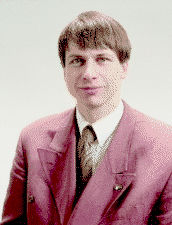
Assistant Professor, Department of Computer Software
Doctor of Philosophy in Engineering 1999 (University of Tsukuba)
Diplom-Informatiker 1991 (Technical University of Darmstadt)
Dr. Herder came to the University of Aizu from Symbolics Systemhaus, Germany. He had worked for two years as a software engineer at the fix-priced project "admin" for the airline company Lufthansa. The result was the foundation for a flight schedule workbench in the form of an object-oriented, version-controlled database.
He was responsible for the development of a prototype "The Common Lisp Interface Manager Builder", a cooperative project between Symbolics Systemhaus and FZI (Forschungszentrum Informatik) at the University of Karlsruhe.
In 1990 he received 4th Place in the International Hessen Prize for Graphical Data Processing (Dr. Jrgen Schneider Stiftung) in cooperation with V. Jung for his contribution in developing the texture synthesis language HiLDTe.
He currently lectures Programming III: Introduction to Java with principles for concurrent and network programming. He tought Computer Graphics, Programming I and II (C/C++), Algorithms and Datastructures and is involved in student research projects on virtual reality.
Currently, he is a member of the Spatial Media Group where he manages the design of the Sound Spatialzation Framework. He participated in the Intelligent Health Care System Project where he managed the design of the user interface.
Multimedia and three-dimensional graphics must be more tightl integrated. Nowadays, we see a lot of applications of multimedia in two-dimensional space. Multimedia should not have this limitation, and in our research we put multimedia data into three-dimensional space.
Semantics in multimedia applications is expressed by the application itself. A lot of applications are similar in structure to hypertext systems. They allow one to find some multimedia information via a graph. Such systems are called hypermedia systems.
In our object-oriented approach, the objects interact with the user or other objects on their own. The application's task is only to moderate the interaction and to provide some basic services including a tool-box to the objects.
Multimedia data such as audio and video are strongly time dependent. We want to find a representation which allows us to use and easily manipulate them together with graphics.
Industry needs a standard for three-dimensional data including multimedia for saving on future investments in hard- and software. Based on such standards a wide array of portable applications may be developed.
e-mail: herder@u-aizu.ac.jp